



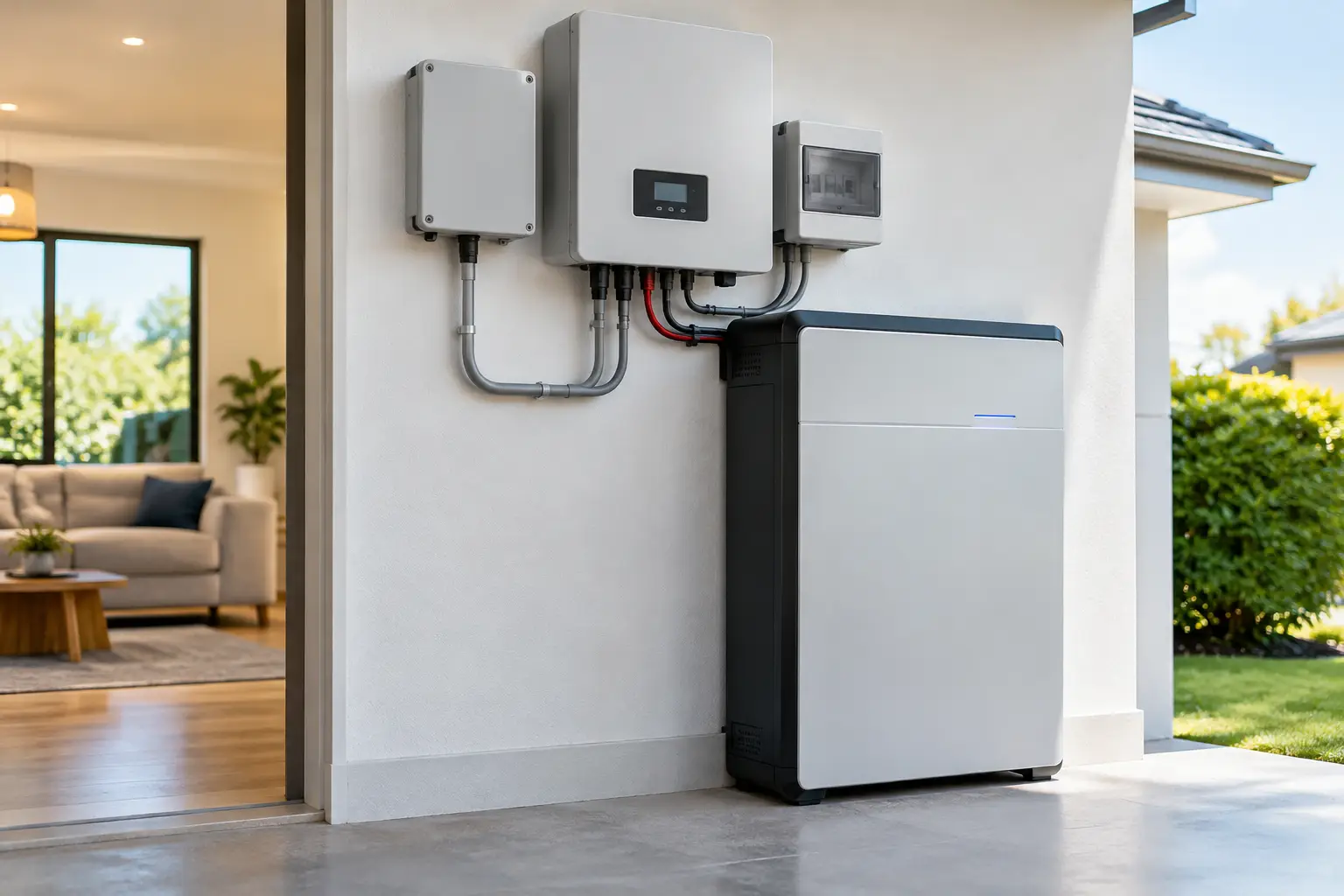
17 Oct How Battery Backup Works in Your SA Home
A battery is not simply a box that stores spare solar power. In a well-designed South Australian solar system, it can decide when to charge, when to support your home, when to export energy, and what remains powered if the grid goes down. Understanding how battery backup works makes it much easier to choose a system that suits your household, property or business.
For many SA households, the goal is straightforward: use more of the solar energy produced on the roof, buy less electricity during expensive periods, and have practical protection from outages. The right result depends on your electricity use, solar output, switchboard setup and the level of backup you actually need.
How battery backup works with solar power
During the day, solar panels generate direct current electricity. Your solar inverter converts that electricity into the alternating current used by appliances, lights and power points around the home. Solar power is generally used first by whatever is operating at the time.
If your panels are generating more than the home needs, that surplus can be directed into a battery instead of being sent straight to the grid. Once the battery reaches its set charge level, any remaining surplus may be exported to the grid, depending on the system settings and connection arrangement.
Later, when solar production drops or stops, the battery can discharge to cover some or all of your household demand. This is particularly useful in the evening, when families are cooking, running heating or cooling, charging devices and using more electricity than the panels can produce.
When the battery reaches its minimum reserve level, the home draws electricity from the grid as normal. The reserve is not usually zero. A battery management system keeps a protected amount of capacity to support battery health and, where selected, maintain power for an outage.
The battery management system does the hard work
Every quality battery system includes controls that monitor energy flowing between the solar panels, battery, household loads and grid. These controls respond continuously, often in seconds, to changing conditions.
They manage charging and discharging within safe operating limits, protect the battery cells from excessive heat or deep discharge, and help prioritise energy according to the system design. Depending on the product and settings, a battery may be programmed to retain a backup reserve, charge from solar only, or use lower-cost grid electricity at selected times.
This is why the battery itself is only one part of the solution. The inverter, monitoring equipment, switchboard integration and installation quality all affect how reliably the system performs.
What happens during a blackout?
A common assumption is that solar panels will keep a house running whenever the sun is shining. In a standard grid-connected solar system, that is not the case. When the grid fails, conventional solar systems shut down for safety. This prevents electricity from feeding back into the network while crews are working on lines.
To provide backup during an outage, the system needs suitable battery backup capability and the equipment required to safely isolate the property from the grid. Once the grid is isolated, the battery can create a stable local power supply for selected circuits. If there is enough sunlight and the system is configured for it, solar panels may then recharge the battery and contribute to the backed-up loads.
The changeover is typically automatic. Some systems restore selected circuits so quickly that the interruption is barely noticeable, while others may have a brief transition. The precise experience depends on the battery, inverter and backup configuration.
Essential backup versus whole-home backup
Not every battery backup system is designed to run every circuit in the home. Essential backup usually covers the loads that matter most during an outage, such as lighting, refrigeration, internet equipment, selected power points, garage access and a few kitchen appliances.
Whole-home backup aims to supply a larger portion of the property. It can be an excellent option for homes with suitable electrical infrastructure and carefully managed demand, but it needs more planning. Large appliances such as ducted air conditioning, electric ovens, hot water systems, pool pumps and EV chargers can draw substantial power, particularly when several operate at once.
The key consideration is not just battery capacity. It is also power output. Capacity, measured in kilowatt-hours, indicates how much stored energy is available. Power output, measured in kilowatts, indicates how much the battery can deliver at one time. A battery may have enough stored energy for an extended outage but still be unable to run multiple high-demand appliances simultaneously.
For regional properties, the distinction can be especially important. A considered backup plan can keep communications, refrigeration, water pumps or critical equipment operating without attempting to power every load as if the grid were still available.
How long does battery backup last?
There is no single answer because runtime changes with the battery size, state of charge, household demand and available solar generation. A modest essential-load setup can last considerably longer than a system trying to support an entire home with air conditioning, cooking and other high-consumption appliances.
Consider two homes with the same battery. One uses it overnight for a fridge, lights, Wi-Fi and a few small appliances. The other is also running heating or cooling, an electric cooktop and several entertainment devices. Their backup times will be very different.
Daytime solar can extend runtime during an outage, but sunshine is not a guarantee of unlimited power. Cloud cover, winter production, panel orientation and the electricity being used at that moment all matter. A well-designed system balances solar generation, storage and sensible load management rather than promising that one battery will cover every possible scenario.
Battery backup and lower electricity bills
Backup power is valuable, but it is only one reason South Australians install batteries. For many households, the daily financial benefit comes from storing excess daytime solar and using it later instead of buying as much electricity from the grid.
This is often called solar self-consumption. Rather than exporting every unused kilowatt-hour during the day, you retain more of that energy for the evening. Your savings will depend on your tariff, export arrangement, solar generation, battery size and how closely your energy use matches the battery’s operating pattern.
A battery can also be useful where electricity plans have different rates at different times of day. However, tariff-based charging strategies should be assessed carefully. They can reduce grid costs in some circumstances, but they are not automatically the best option for every household. Preserving battery capacity for solar storage or outage protection may be more valuable to you.
For eligible customers, government-backed battery incentives and programs may improve the case for installation. Availability, eligibility requirements and program conditions can change, so it is worth having your options checked as part of a proper system recommendation rather than relying on general advice.
Choosing the right backup setup
A quality recommendation begins with your real electricity habits, not a one-size-fits-all battery size. Your installer should examine consumption data where available, the output of your existing or proposed solar system, roof generation patterns, major appliances and your priorities during a blackout.
It also helps to decide what you want backup to achieve. Some owners mainly want evening bill savings and enough reserve for lights and refrigeration. Others need stronger resilience for a regional home, work-from-home setup, medical equipment or business operations. Commercial sites may need a staged approach that protects key loads first while managing larger demand separately.
The physical installation matters too. Battery location, ventilation, clearances, weather exposure, cabling routes and switchboard capacity must all be considered. Premium options such as Tesla Powerwall and BYD battery systems can provide flexible solutions, but the best product is the one correctly matched to the property and installed to applicable Australian requirements.
Why professional design matters
Battery backup is electrical infrastructure, not a plug-in appliance. A system that is poorly sized or incorrectly configured may leave you with limited outage protection, less bill reduction than expected or backup circuits that do not reflect how you actually live.
An experienced, accredited installer can explain the trade-offs clearly: whether essential or broader backup is appropriate, how much battery reserve to keep, which appliances should sit on protected circuits, and whether your current solar system can be integrated effectively. They can also ensure the design accounts for the requirements of the local network and your property’s electrical setup.
Allstate Solar helps South Australian households, regional property owners and businesses plan solar and battery solutions around practical energy outcomes, not assumptions. The right design should give you confidence in normal daily use as well as when the grid is unavailable.
Before choosing a battery, write down the appliances and circuits you would genuinely want operating in an outage, then compare that list with your normal evening consumption. That simple exercise gives a qualified installer a far clearer starting point and helps turn battery backup from a vague promise into a dependable plan for your property.
No Comments