



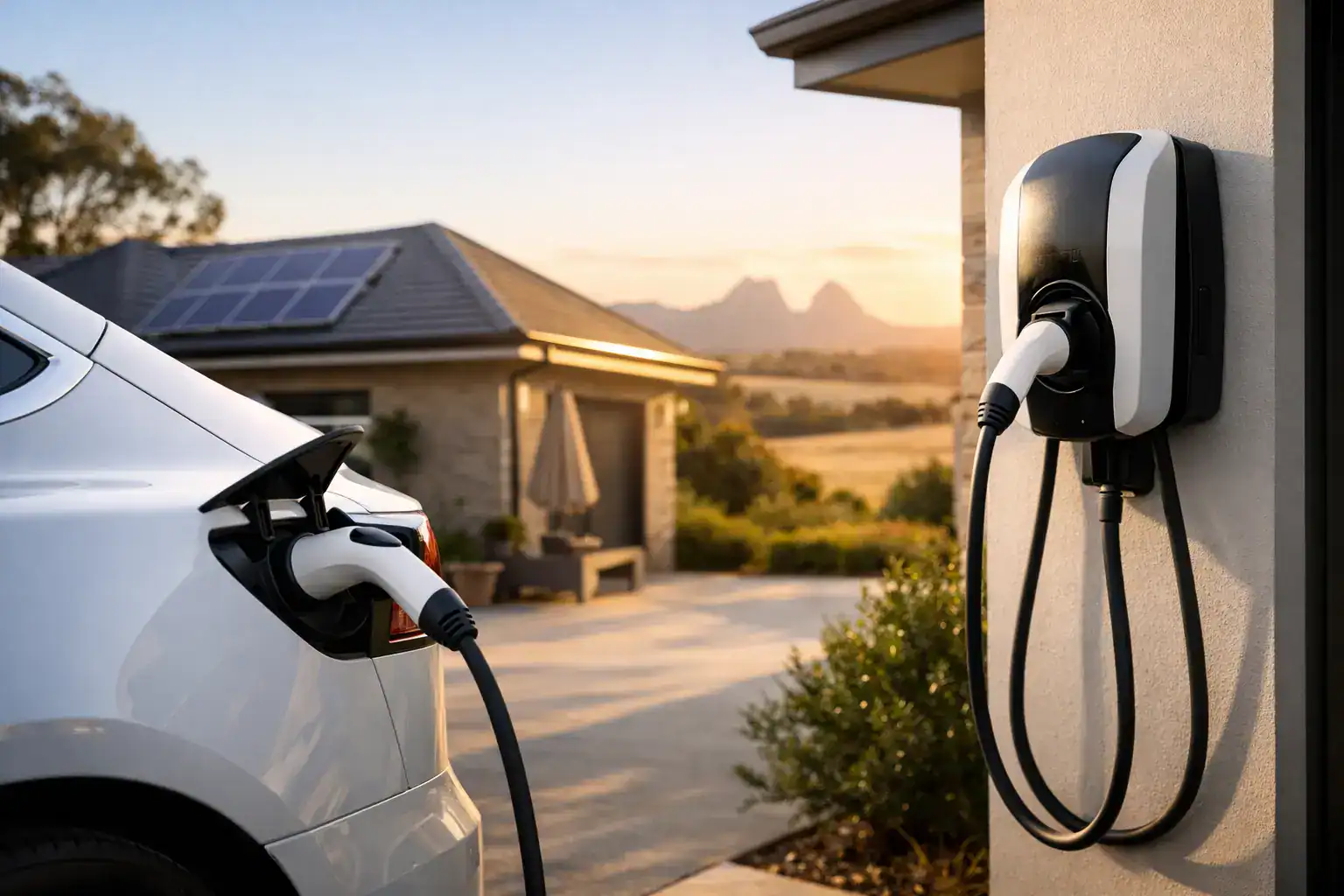
06 Aug Best EV Chargers Home for South Australian Drivers
Your EV may come with a portable charging cable, but plugging it into a standard power point every night is rarely the best long-term answer. For South Australian households, the best EV chargers home setup is one that suits the vehicle, the property’s electrical capacity and the way the family uses solar power.
A properly selected and professionally installed home charger gives you faster, safer, more predictable charging. It also puts you in a better position to use solar generation during the day, reduce reliance on grid power and make electric driving work around your real routine rather than the other way around.
What makes the best EV chargers home setup?
The best charger is not simply the unit with the biggest number on the box. Charging speed matters, but so do compatibility, switchboard capacity, cable length, charging schedules and where the vehicle is parked each day.
Most Australian homes are well suited to a Level 2 AC charger. These chargers are hardwired by a licensed electrician and generally provide much faster charging than a standard wall socket. For many households, that means returning home, plugging in and waking up with enough charge for the next day’s driving.
The right option depends on how far you travel, whether you have one or two EVs, and whether charging happens overnight or during solar-producing hours. A household with a short daily commute may be perfectly served by a moderate charging rate. A regional property owner covering longer distances, or a family with multiple electric vehicles, may benefit from a higher-capacity installation if the property can support it.
Your EV’s charging capacity comes first
Every EV has an onboard AC charger that sets the maximum rate it can accept from a home charger. Installing a charger capable of a higher output does not necessarily mean your current vehicle will charge faster. It can, however, provide useful flexibility for a future vehicle upgrade.
Your installer should confirm the connector type, the car’s AC charging capability and the cable arrangement that makes daily use easiest. Tethered chargers have a fixed cable attached, which is convenient when you park in the same position every day. Socketed units allow you to use a separate cable and can offer more flexibility where vehicle types may change.
Your switchboard and supply need a proper assessment
A home EV charger is a significant electrical load. Before recommending a unit, a qualified installer needs to assess your switchboard, incoming supply, existing major appliances and available circuit capacity.
This is especially important in homes with ducted air conditioning, electric hot water, pool equipment, induction cooking or a home battery. In some properties, the charger can be installed without major electrical changes. In others, switchboard upgrades, load management or other electrical work may be needed to keep the installation safe and compliant.
A site assessment is not an optional extra. It is how a charger is matched to the home correctly the first time.
Solar can make home EV charging work harder
For many South Australian solar households, charging an EV is another way to use more of the energy produced on the roof. Rather than exporting surplus solar generation during the middle of the day, you may be able to direct some of that energy into the vehicle.
The practical outcome depends on your solar system size, household demand, weather and the charger’s controls. If everyone leaves home during daylight hours, scheduled overnight charging may be more realistic. If one vehicle is home during the day, solar-aware charging can be an excellent fit.
Smart chargers can be configured to charge at set times, respond to electricity tariffs and, in suitable setups, adjust charging around available solar generation. This gives households more control without requiring someone to manually manage charging every afternoon.
A home battery can add another layer of flexibility, but it should be planned carefully. Charging a vehicle from stored battery energy may make sense in certain circumstances, while at other times it may be better to preserve battery capacity for evening household use. The right strategy should reflect your energy goals, not just the latest technology.
Choose the charging speed around your routine
Charging power is usually discussed in kilowatts, but daily convenience is the better measure. Think about how many kilometres you typically drive, when the car is parked at home and how much spare time you have to recharge.
A lower-output home charger can be a sensible choice when the vehicle is parked for long periods and daily driving is modest. A higher-output option may suit busy households, drivers with longer daily travel or homes where more than one EV needs charging. It is also worth considering whether your energy use will change over the next few years.
Do not assume the fastest charger is automatically the right investment. Your vehicle may limit the rate, your electrical supply may call for a different approach, and your charging window may be long enough that a moderate rate does the job comfortably. Good advice should balance current needs with realistic future plans.
Where the charger is installed matters more than people expect
The best location is usually close to where the car parks, with a cable route that is tidy, practical and safe. A garage is straightforward for many homes, but carports, driveways and external walls can also be suitable when the equipment is selected and installed for the conditions.
Consider which side of the car the charge port sits on, where the cable will reach, and whether anyone could trip over it. The charging unit should be accessible without creating a hazard across a walkway, garage entrance or shared parking area.
For rural and regional properties, the distance from the switchboard to the parking area can influence installation design. Longer cable runs, sheds and detached garages need to be assessed carefully. The goal is a durable solution that is suited to the site, rather than a one-size-fits-all installation.
Features worth asking about
Smart features are useful when they solve a real household problem. Charging schedules can help you use off-peak electricity periods where available. App monitoring can show charging status and energy use. Load management can help prevent the charger from placing too much demand on the home when other major appliances are running.
For solar households, look for a charger that can support the charging approach you want. That may mean simple timed charging, solar surplus charging or a combination that changes with the season. The right feature set should be easy to use day after day. Complex controls are of little value if no one wants to touch them after installation.
If you are planning for two electric vehicles, ask about options that allow charging to be managed across both vehicles. This can avoid unnecessary strain on the home supply while still giving each vehicle the charging it needs.
Why professional installation is essential
A home EV charger must be installed in line with applicable Australian electrical requirements. It needs the correct dedicated circuit, protective devices, cable sizing and commissioning. It should also be tested before being handed over.
This is not work for a general handyman or an unverified installer. An EV charger affects one of the most critical systems in your home, and the quality of the electrical work matters for safety, performance and future serviceability.
At Allstate Solar, EV charger recommendations can be considered alongside your solar PV system, battery storage and household energy use. That whole-of-home view helps prevent a charger from being treated as a standalone purchase when it is really part of your broader energy plan.
Get an EV charger plan built for your property
The strongest starting point is a conversation about your vehicle, daily kilometres, parking arrangement, switchboard, solar system and future plans. Bring up anything that may affect demand, including electric heating, pool pumps, batteries or a second EV on the horizon.
A properly designed home charger should feel simple once it is installed: park, plug in and let the system do its job. Contact a qualified South Australian team to assess your property and build a charging solution that supports the way you live, drive and use energy.
No Comments